I live in a 32-square-meter studio apartment in Paris. One day I wondered what it would feel like to invite friends into a perfect virtual copy of this exact space. Not a stylized recreation, but a digital twin accurate enough that I could navigate it blindfolded in VR while physically walking around my real home.
The goal was simple on paper: create a photorealistic VR replica I could eventually import into VRChat. I wanted free movement, enhanced lighting, and the strange sensation of occupying both realities at once. This was November 2021, before the metaverse hype fully collapsed. I had an Oculus Quest 1 and too much free time during lockdown.
I started with photogrammetry. I downloaded Polycam on my phone and spent two afternoons walking around the apartment taking hundreds of photos. The app generated a textured mesh surprisingly fast. I imported the result into Unity expecting to be almost done.
The mesh was unusable for VR. Walls were bumpy, edges were soft, and the texture quality collapsed under close inspection. Floors had holes where my feet had been. Furniture came out as blobby masses. Even after aggressive optimization the performance on Quest 1 was terrible. I realized consumer-grade photogrammetry still couldn't deliver the precision I needed for a convincing interior.
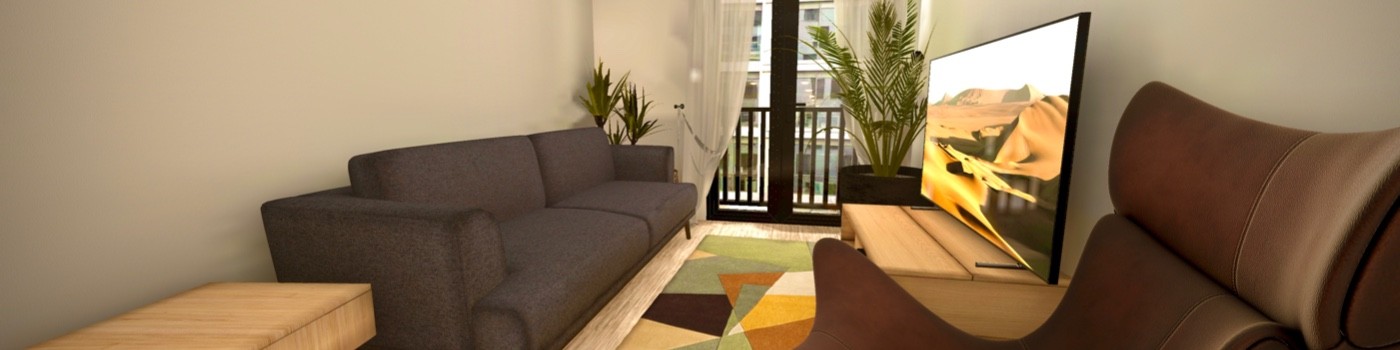
The scan did give me one valuable thing: real-world scale. I kept the rough mesh hidden in the scene as a reference and started over with manual modeling. I measured every dimension again with a laser measurer, then photographed every flat surface under consistent lighting. I rebuilt the walls, floor, and ceiling as clean geometry in Unity.
I replaced the low-quality scan textures with photographs I took myself. I shot the wooden floor, the white walls, the kitchen tiles, and the fabric of my sofa at high resolution, then cleaned them in Photoshop. For complex objects like my desk lamp and bookshelves I downloaded high-quality models from Sketchfab and adjusted their materials to match my real items. The key was consistency in lighting and scale rather than perfect geometric accuracy.
The modeling phase took about three weeks of evenings. I kept the polycount low enough for the Quest 1 while pushing visual fidelity through careful material work and baked lighting. I used Unity's built-in render pipeline because the Universal Render Pipeline at the time had limited VR support on Quest. I added subtle post-processing to enhance the sense of depth without destroying performance.
Testing the experience was the most interesting part. I would put on the Quest 1, start the scene, then physically walk around my real apartment while moving in the virtual one. The alignment was close enough that I could sit on my real sofa and land exactly on the virtual sofa. I could reach for my real desk and find the virtual desk in the same place. The brain accepts this overlap surprisingly well when the proportions match.
I recorded a short demonstration and posted it on YouTube. The video shows me walking from the kitchen area to the bed while wearing the headset. The motion is natural because I'm actually walking those steps in reality. The comment that surprised me most was from someone who recognized the exact layout of my apartment from previous videos I had posted. The digital twin was accurate enough to be identifiable.
The project revealed several practical lessons about building personal digital twins. First, photogrammetry is excellent for capturing overall proportions but poor for production-ready interiors. The time saved in initial scanning is lost in cleanup. Manual modeling with reference photos remains faster for small spaces.
Second, the value of these experiences comes from spatial alignment between real and virtual. When the two match, presence becomes dramatically stronger. I felt more "at home" in the virtual apartment than in most professionally built VR environments. The brain uses real-world proprioception as an anchor.
Third, the DIY metaverse idea still makes sense. Instead of waiting for corporate platforms to build convincing social spaces, individuals can create their own. I could invite friends into an exact copy of my living room. We could watch movies together on my virtual television while sitting on my virtual sofa. The technology already exists today.
I eventually exported the scene to work inside VRChat. The import process required some material adjustments but the core geometry transferred cleanly. Having my own apartment as a persistent virtual hangout space changed how I thought about social VR. It stopped feeling like visiting someone else's world and started feeling like inviting people into mine.
There were clear constraints I accepted from the beginning. I didn't try to make the twin dynamic. The windows don't show real-time weather. The refrigerator doesn't contain actual food that changes. This is a static snapshot, not a living simulation. That decision kept the project manageable while still delivering the core experience I wanted.
Looking back, I would approach the texture work differently. I now know that shooting with a proper camera instead of a phone would have saved hours of cleanup. I would also spend more time on lighting variation. The baked lighting is convincing but lacks the subtle changes that happen throughout the day in the real apartment.
The project taught me that digital twins don't need to be perfect to be meaningful. They need to be spatially accurate and visually coherent. Users forgive minor geometric errors if the overall feeling of the space is right. This is especially true for personal environments where emotional connection already exists.
I continue to use this digital twin when I want to show people my apartment without inviting them physically. The VR version lets me control the lighting and remove visual clutter. It becomes a presentation tool as much as a social space. Friends who visit virtually often comment on details they never noticed when they visited in reality.
The experience also changed how I see my physical apartment. Having a virtual copy made me more aware of spatial decisions I had made unconsciously. I rearranged some furniture after noticing how certain layouts felt in VR. The digital version became a design tool for the real space.
For anyone considering a similar project, start with accurate measurements rather than scanning technology. Use photogrammetry only as a reference. Focus on materials and lighting over geometric perfection. Test early and often by physically walking the real space while wearing the headset. The alignment between realities matters more than visual polish.
This remains one of my favorite personal projects because it required no budget beyond time and delivered an experience that still feels slightly magical. I can stand in my tiny Paris studio and simultaneously occupy a clean, well-lit, perfectly organized version of the same space. The boundary between real and virtual becomes productively blurry.
The DIY metaverse doesn't require waiting for big tech to solve all the problems. It can start with something as simple as copying your own living room. From there, the possibilities for personal expression and shared experience expand naturally. I still load this scene occasionally when I need to remember what my apartment felt like during that specific period of my life. Digital twins preserve space as well as they preserve data.